
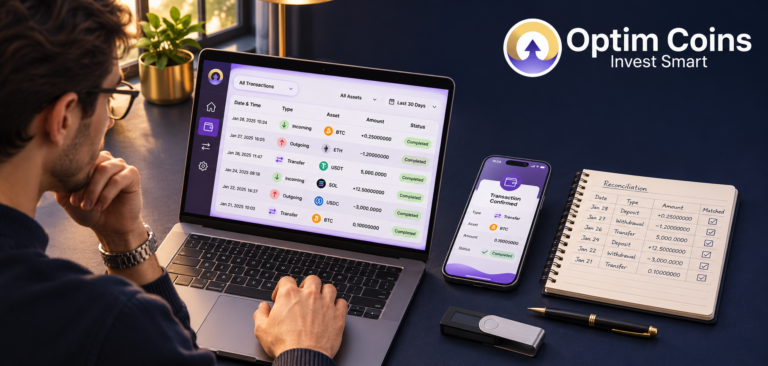
Crypto Portfolio Management: How to Track Deposits, Withdrawals and Transfers
Crypto portfolio management involves understanding how money and digital assets move across your accounts. A higher balance may reflect a new deposit rather than an investment gain, while a lower exchange balance may result from a transfer to your own wallet rather than a sale.
Keeping deposits, withdrawals and transfers clearly labelled helps explain these changes. It also makes it easier to check fees, match transactions and avoid counting the same movement twice.
If you use or are considering OptimCoins Australia, check which transaction records are available and maintain a consistent record across the accounts and wallets included in your portfolio.
Why Is Tracking Portfolio Movements Important?
An account balance shows what is held in one place. It does not explain whether the balance changed because you added money, bought an asset, withdrew cash or moved an existing holding.
For example, depositing A$500 into an exchange increases the money held there. Buying crypto with that deposit changes the composition of the account. These are separate events, but they do not represent two separate contributions.
Key Terms to Understand
- Deposit — Money or crypto credited to an account or wallet.
- Withdrawal — Money or crypto debited from an account or wallet.
- Internal transfer — A movement between accounts or wallets within your defined portfolio.
- External contribution — New money or assets entering the portfolio from outside its defined boundary.
- External withdrawal — Money or assets leaving that portfolio boundary.
- Reconciliation — Comparing recorded movements with source records and balances.
1. Define Which Accounts Belong to Your Portfolio
Start by listing the accounts and wallets your portfolio report covers. This determines whether a movement is internal or external.
If your report includes an exchange account and a personal wallet, moving an asset between them is an internal transfer. If your everyday bank account sits outside the report, transferring money from that bank account into the exchange is an external contribution.
Details to Record for Each Account
- Platform or wallet label.
- Account owner.
- Assets or currencies held.
- Whether the account is included in the portfolio.
- Opening balance and starting date.
- Available statements or transaction exports.
Use the same portfolio boundary throughout each reporting period. Document changes when adding another account or wallet.
2. Use Separate Categories for Deposits, Trades and Transfers
A platform’s transaction label describes activity within that platform. Your portfolio record also needs to explain the purpose of the movement.
A crypto deposit could be a transfer from your own wallet, a purchase received from elsewhere or another type of receipt. Investigate the source before assigning a category.
Common Activities to Track
Activity | What to establish |
Cash deposit | Where the money came from and whether it is a new contribution |
Cash withdrawal | Where the money went and whether it left the portfolio |
Crypto deposit | Source, asset quantity and reason for receipt |
Crypto withdrawal | Destination, quantity debited and associated fees |
Internal transfer | Matching source and destination records |
Purchase or sale | Assets or cash exchanged and trading fees |
Other receipt | Source and nature of rewards, payments or other credits |
Keep unclear entries marked for review rather than automatically treating every incoming amount as an investment gain.
3. Record Cash Deposits Without Counting Purchases Twice
When money moves from your bank account to an exchange, record the funding event separately from any later purchase.
The deposit explains how cash entered the portfolio. The purchase explains how that cash was used.
Details to Capture for a Cash Deposit
- Date, time and time zone.
- Sending bank account label.
- Receiving platform account.
- Currency and amount sent.
- Amount credited.
- Any separately charged fee.
- Bank and platform references.
- Transaction status.
If A$500 arrives at the exchange and you later use A$300 to purchase crypto, the contribution remains A$500. The purchase does not add another A$300 of external funding.
4. Separate Crypto Sales From Cash Withdrawals
Selling crypto and withdrawing the proceeds are different events. A sale changes crypto into cash within the account. A withdrawal moves that cash elsewhere.
Record both events so you can explain the asset disposal, cash balance and subsequent movement.
Information to Keep Separate
- Crypto quantity sold.
- Gross sale proceeds.
- Trading fee.
- Net cash credited.
- Cash amount withdrawn.
- Withdrawal fee, if any.
- Amount received by the destination account.
A cash withdrawal does not, by itself, establish how much investment profit you made. It may contain original contributions, sale proceeds or a combination of funds.
5. Match Both Sides of Transfers Between Your Own Wallets
Link the sending record to the receiving record. This helps prevent portfolio software or a spreadsheet from treating the outgoing amount as a sale and the incoming amount as a new purchase.
Transfer Details to Record
- Sending account or wallet.
- Receiving account or wallet.
- Asset and network.
- Total quantity debited.
- Quantity credited at the destination.
- Fee amount and fee asset.
- Transaction hash or platform reference.
- Status at both ends.
For Australian tax purposes, the ATO distinguishes a transfer between wallets where ownership is maintained from a disposal. Crypto used to pay a network fee can have separate capital gains consequences. Keep the fee identifiable in your records. ato.gov.au
6. Record Fees Without Deducting Them Twice
Check how the source record presents each fee. A withdrawal amount may already include the fee, or the platform may charge it separately.
Record the actual debit and credit before calculating the difference.
Fee Questions to Ask
- Is the displayed quantity gross or net?
- Was the fee deducted from the transferred asset?
- Was it charged in another asset?
- Does the total account debit already include the fee?
- Is the listed charge a platform withdrawal fee or a separate network fee?
- Have I already imported this charge from another record?
If 20 units leave an account and 19.8 units arrive, a documented 0.2-unit fee can explain the difference. Do not subtract that fee again from the destination balance.
7. Work Through a Hypothetical Deposit, Purchase and Transfer
Suppose your portfolio includes an exchange account and a personal wallet, while your bank account sits outside it.
You deposit A$1,000 into the exchange. You then purchase 100 units of a hypothetical asset for A$800 and pay a separate A$4 trading fee.
Later, you transfer 40 units to your own wallet. The exchange debits 40 units in total, and the wallet receives 39.5 units after a 0.5-unit withdrawal fee.
Hypothetical Portfolio Entries
Activity | Source debit | Destination credit | Classification |
Bank deposit | A$1,000 from bank | A$1,000 to exchange | External contribution |
Crypto purchase | A$804 from exchange cash | 100 asset units | Purchase with A$4 fee |
Transfer to own wallet | 40 asset units from exchange | 39.5 asset units to wallet | Internal transfer with 0.5-unit fee |
Cash withdrawal | A$100 from exchange | A$100 to bank | External withdrawal |
<h3> What the Example Shows </h3>
After these events, the portfolio holds:
- A$96 in exchange cash.
- 60 asset units on the exchange.
- 39.5 asset units in the personal wallet.
Net external contributions are A$900: A$1,000 deposited minus A$100 withdrawn.
The internal crypto transfer does not create another contribution. The combined asset quantity falls from 100 to 99.5 units because of the recorded fee. The portfolio’s current AUD value depends on the asset’s valuation at the review time.
8. Keep Transaction Dates and Statuses Clear
A withdrawal may appear in the sending account before the receiving account credits it. Different time zones can also make matching records appear on different dates.
Preserve the original timestamps and use a consistent reporting time zone.
Status Details to Track
- Requested.
- Processing.
- Completed at the source.
- Credited at the destination.
- Failed or cancelled.
- Reversed.
- Awaiting clarification.
For a transfer crossing a reporting cutoff, identify it as in transit and reconcile it explicitly. Avoid counting it both as a destination holding and as an additional in-transit asset.
9. Separate External Cash Flows From Portfolio Performance
A rise in portfolio value can result from additional funding, investment performance or both.
For a simple dollar reconciliation over a period:
Change after external flows = Closing portfolio value − Opening portfolio value − External contributions + External withdrawals
Use consistent valuations and include all assets and cash within the defined portfolio.
Hypothetical Example
A portfolio starts at A$2,000. During the period, you contribute A$500 and withdraw A$100. Its closing value is A$2,450.
The change after external flows is:
A$2,450 − A$2,000 − A$500 + A$100 = A$50
This is a dollar change after adjusting for external flows. It is not a percentage return or a tax calculation. Percentage performance measurement also needs to account for the timing of contributions and withdrawals.
10. Keep Source Records and AUD Values Clearly Labelled
Save the evidence supporting each movement. Record actual AUD amounts separately from estimated AUD values assigned to crypto transfers.
The ATO’s record-keeping guidance includes transaction dates, purposes, counterparties, exchange records and AUD values at the time of transactions. ato.gov.au
Useful Records to Retain
- Bank deposit and withdrawal confirmations.
- Exchange account exports.
- Trade confirmations.
- Wallet transaction histories.
- Transaction hashes and platform references.
- Fee records.
- Valuation sources and calculation notes.
- Explanations for corrected or unmatched entries.
Use account labels in your journal. Keep passwords, private keys and recovery phrases out of spreadsheets and shared transaction records.
11. Reconcile Each Account Before Reviewing the Combined Portfolio
Check one currency or asset in one account at a time. Compare the opening balance with confirmed credits, debits and the closing balance.
Once individual accounts reconcile, review the combined portfolio and match internal transfers.
Items to Investigate
- Transfers missing a receiving entry.
- Fees charged in a different asset.
- Duplicate imports from overlapping exports.
- Pending movements at the reporting cutoff.
- Reversed deposits or withdrawals.
- Rounding differences.
- Incorrect opening balances.
- Transactions assigned to the wrong wallet.
Do not add an unexplained adjustment simply to make the totals match. Keep the difference visible until supporting records explain it.
12. Maintain a Regular Recording Routine
Update your records while references and confirmations are easy to locate. If you import activity in batches, record the previous import cutoff.
A Simple Tracking Routine
- Save the bank, exchange or wallet record.
- Classify the movement and confirm its source and destination.
- Enter quantities, currencies, fees and timestamps.
- Link both sides of internal transfers.
- Mark incomplete movements for follow-up.
- Reconcile individual balances.
- Review external contributions and withdrawals separately from performance.
A Practical Crypto Portfolio Movement Checklist
Review area | What to establish |
Portfolio boundary | Accounts and wallets included in the report |
Classification | Deposit, withdrawal, trade, transfer or other receipt |
Ownership | Whether assets remain under the same ownership |
Quantities | Actual amounts debited and credited |
Fees | Amount, fee asset and charging method |
References | Bank reference, platform ID or transaction hash |
Timing | Original timestamps and reporting time zone |
Status | Completed, pending, failed or reversed |
External flows | Contributions and withdrawals across the portfolio boundary |
Reconciliation | Explained opening and closing balances |
Questions OptimCoins Users Should Ask
If you use OptimCoins Australia, confirm which records are available rather than assuming every movement appears in a particular export format.
Useful Questions Include
- Can I download deposit, withdrawal and transaction histories?
- Which time zone is used?
- Are fees listed separately?
- Does a withdrawal figure include the fee?
- Which reference identifies each movement?
- How are pending or reversed transactions displayed?
- Can I obtain opening and closing account balances?
Common Crypto Portfolio Tracking Mistakes to Avoid
- Counting a deposit and the resulting purchase as two contributions.
- Treating every crypto deposit as income or profit.
- Recording an internal transfer as a sale and a new purchase.
- Confusing a cash withdrawal with realised investment profit.
- Deducting a fee already included in a net amount.
- Counting an in-transit transfer twice.
- Importing the same movement from several sources without matching it.
- Calculating performance without adjusting for external flows.
Keeping Your Crypto Portfolio Records Clear
Define which accounts belong to your portfolio, then record where each movement starts and ends. Separate external funding from trades, link internal transfers and document fees using the actual debits and credits.
Use those records to reconcile balances before assessing performance. For tax reporting, review the underlying transaction and ownership details rather than relying only on platform labels.