
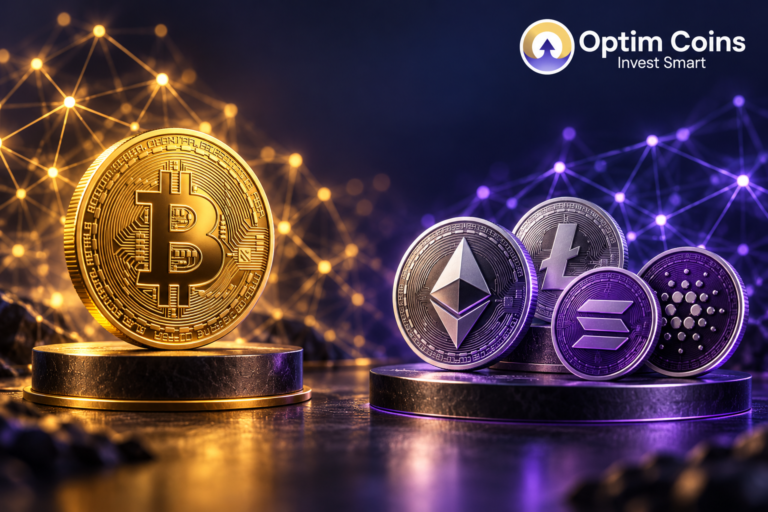
Bitcoin vs Altcoins: Understanding the Main Differences
Understanding Bitcoin vs altcoins helps cryptocurrency users compare assets that may have different purposes, supply rules, security models and practical uses.
Bitcoin is one specific cryptocurrency operating on its own network. “Altcoins” is a broad term commonly used for cryptocurrencies other than Bitcoin. It groups together projects that can differ substantially from one another.
Some support payments, while others power blockchain applications, provide governance functions or aim to track another asset’s value. Their shared classification does not mean they offer similar benefits or risks.
For people using or considering OptimCoins, the useful starting point is to understand the exact asset and network involved rather than choosing solely by price, popularity or the Bitcoin-versus-altcoin label.
What Is Bitcoin?
Bitcoin is a cryptocurrency designed to support peer-to-peer transfers without requiring a central payment operator.
Its native asset is identified by the ticker BTC. Transactions are recorded on the Bitcoin blockchain, with miners contributing proof of work and validating nodes checking compliance with network rules. Bitcoin’s official explanations describe how mining, signatures and confirmations support this process. Bitcoin
Important characteristics include:
- A native asset used for transfers and network fees.
• A public transaction history.
• Proof-of-work consensus.
• A supply schedule governed by protocol rules.
• The ability to hold and transfer fractional units.
Bitcoin is often discussed as a payment asset or potential store of value. Those descriptions do not guarantee stable purchasing power or future price growth.
<h2>What Are Altcoins?</h2>
“Altcoin” is a category label, not a technical standard.
It commonly includes cryptocurrencies other than Bitcoin, although some discussions treat established assets or stablecoins as separate categories.
Examples of assets often included are:
- Native coins of other blockchains.
• Tokens issued through smart contracts.
• Governance tokens.
• Payment-focused cryptocurrencies.
• Stablecoins.
• Meme-based tokens.
These assets can have very different structures. A native blockchain coin and a token issued by a company should not automatically be assessed in the same way.
Coins and Tokens Are Different Concepts
A native coin belongs to its own blockchain network.
A token is issued or represented using an existing blockchain’s infrastructure.
For example, Ethereum is a blockchain platform, and ether, identified as ETH, is its native cryptocurrency. Applications on Ethereum can also issue separate tokens.
Buying a token does not necessarily provide ownership of the underlying network, a company or a share of its revenue.
Bitcoin vs Altcoins Compared
Aspect | Bitcoin | Altcoins |
Meaning | One specific cryptocurrency and network | Broad category of other crypto assets |
Purpose | Peer-to-peer value transfer and related uses | Payments, applications, governance and other purposes |
Native asset | BTC | Depends on the project |
Supply | Protocol rules limit issuance to approximately 21 million BTC | Fixed, variable, inflationary or otherwise designed |
Consensus | Proof of work | Varies by blockchain |
Application design | Bitcoin scripting and additional application layers | Some platforms support general-purpose smart contracts |
Governance | Changes depend on adoption across participants | May involve developers, foundations, holders or administrators |
Fees | Depend on Bitcoin transaction characteristics and demand | Depend on the network and transaction |
Security | Depends on Bitcoin’s protocol and network assumptions | Must be assessed individually |
Investment risk | Volatility, custody and other risks remain | Risks vary widely by asset and structure |
The altcoin column describes a diverse category. It does not apply identically to every project.
1. Compare the Intended Purpose
Start by asking what the asset is designed to do.
Bitcoin focuses on transferring value under its network’s rules. Other projects may pursue different objectives or add functions suited to particular applications.
Ethereum, for example, supports programmable applications through smart contracts. This creates a different usage environment from a straightforward asset transfer. ethereum.org
Questions to Ask
- What problem does the project claim to solve?
• What role does the asset play?
• Is it required to use the network or application?
• Does holding it provide any defined rights?
• Is there evidence of use beyond trading?
• Could the service operate without the token?
A useful application does not automatically make its associated token a suitable investment. The relationship between usage and token demand needs separate examination.
2. Understand Supply and Issuance Rules
Supply affects how ownership is distributed and how new units enter circulation.
Bitcoin’s current consensus rules establish a supply limit of approximately 21 million BTC. Validating software enforces the rules participants choose to follow. bitcoin.org
Altcoin supply designs vary.
They may include:
- A fixed maximum supply.
• Continuing issuance.
• Scheduled token releases.
• Allocations to founders and early investors.
• Token-burning mechanisms.
• Administrative minting powers.
Supply Questions to Review
- How many units currently circulate?
• Is there a maximum supply?
• When can additional units enter circulation?
• Who controls unreleased tokens?
• Can the issuance rules change?
• Does a burn mechanism offset all issuance or only part of it?
Scarcity alone does not establish value. An asset can have a small supply and little genuine demand.
3. Look Beyond the Price of One Coin
A token costing a few cents is not automatically cheaper in valuation terms than Bitcoin.
Unit prices depend partly on how many units exist.
Hypothetical Example:
- Asset A trades at $1 with one billion circulating units.
• Asset B trades at $100 with one million circulating units.
• Asset A’s circulating market capitalisation is $1 billion.
• Asset B’s circulating market capitalisation is $100 million.
Asset A has the lower unit price but the larger circulating valuation.
Market capitalisation is generally calculated as price multiplied by circulating supply. It is not a measure of how much money could be withdrawn from the market at that price.
Bitcoin can also be purchased in fractional amounts. Buying a whole coin is not necessary to obtain exposure.
4. Compare Network Security Models
Different networks use different methods to establish transaction history.
Bitcoin uses proof of work. Some other blockchains use proof of stake or alternative mechanisms.
Ethereum’s proof-of-stake system requires validators to commit ETH and participate in checking and proposing blocks, with penalties applying under specified conditions. ethereum.org
Factors to Examine
- How transactions and blocks are validated.
• Concentration of mining or validation influence.
• Software development and maintenance.
• History of disruptions or security incidents.
• Administrative controls.
• Dependence on bridges or other networks.
For a token, also review the token contract. It may contain powers to pause transfers, change permissions or create additional units, even when the underlying blockchain continues operating normally.
5. Understand Smart-Contract and Application Risks
Some altcoins interact with programmable applications.
These may support lending, trading, gaming or other functions, but they can introduce additional risks.
Examples include:
- Programming vulnerabilities.
• Excessive spending permissions.
• Compromised administrator keys.
• Dependence on external price data.
• Failure of connected protocols.
• Misleading descriptions of token rights.
Bitcoin users can also face risks through exchanges, wrapped assets and additional application layers.
Assess the complete arrangement rather than assuming an asset’s name describes every risk involved.
6. Compare Liquidity on the Relevant Market
Liquidity concerns the ability to trade an asset without materially moving its price.
It varies by trading pair, platform, order size and market conditions.
Useful Checks Include
- Difference between buying and selling prices.
• Available orders near the quoted price.
• Expected slippage for the proposed order.
• Trading restrictions.
• Deposit and withdrawal availability.
• Concentration of trading across venues.
A displayed price does not guarantee that a large order can be executed at that level.
Compare actual trading conditions for the asset and venue involved.
7. Review Transaction Fees and Settlement
Transaction costs depend on more than whether an asset is Bitcoin or an altcoin.
Relevant factors include network demand, transaction complexity and any provider charges.
Costs to Distinguish
- Trading fees.
• Bid–ask spread.
• Blockchain transaction fees.
• Platform withdrawal charges.
• Bridge fees, where applicable.
• Fees for interacting with applications.
A token transfer may require the network’s native coin to pay fees. Holding the token alone may not be sufficient to move it from a self-custodial wallet.
Also distinguish block inclusion from final settlement. Faster advertised block times do not automatically mean stronger settlement guarantees.
8. Assess Governance and Control
Governance concerns how changes are proposed, approved and adopted.
Different projects may involve:
- Open-source contributors.
• Mining or validator participants.
• Foundations.
• Companies.
• Token-holder votes.
• Contract administrators.
Ask who can make important changes and what limits apply.
For governance tokens, examine whether voting power is concentrated and whether token-holder decisions actually control implementation.
A decentralisation claim should be assessed against specific controls rather than accepted as a general label.
9. Treat Stablecoins as a Separate Assessment
Stablecoins are commonly grouped with altcoins, but their intended behaviour differs from assets whose prices float freely.
They aim to maintain a relationship with a reference asset, often a currency. Their mechanisms and backing arrangements vary.
The Reserve Bank of Australia identifies credit, liquidity, operational and settlement risks associated with stablecoin arrangements. A stability objective should therefore not be treated as a guarantee. rba.gov.au
Questions to Ask
- What supports the reference value?
• Who holds or manages the reserves?
• Who can redeem directly?
• What fees and restrictions apply?
• Can the issuer freeze tokens?
• What happens if the market price departs from the target?
A stablecoin linked to the US dollar can also fluctuate in Australian-dollar value as exchange rates change.
10. Understand Volatility and Correlated Risks
Bitcoin and many altcoins can experience substantial price movements.
ASIC’s Moneysmart describes most crypto assets as high-risk investments and highlights their price volatility. Moneysmart.gov.au
Risk can arise from:
- Changes in demand.
• Project-specific problems.
• Security incidents.
• Regulatory developments.
• Large-holder activity.
• Limited liquidity.
• Platform failures.
Holding several cryptocurrencies does not necessarily provide broad diversification. Assets may respond similarly during market stress or depend on the same platforms and infrastructure.
Do not assume that an altcoin must follow Bitcoin’s price or that past relationships will remain stable.
A Practical Bitcoin and Altcoin Research Checklist
Research area | What to establish |
Identity | Exact asset, ticker and supported network |
Purpose | Intended function and evidence of use |
Supply | Issuance, allocations and future releases |
Valuation | Supply-adjusted measures beyond unit price |
Security | Network and token-specific assumptions |
Control | Upgrade, minting, freezing and administrative powers |
Liquidity | Trading conditions for the relevant pair and order size |
Costs | Trading, transfer and withdrawal charges |
Custody | Who controls keys and how recovery works |
Compatibility | Receiving wallet and network support |
Documentation | Primary sources supporting important claims |
Risk | Potential loss, concentration and platform exposure |
Use the same questions when reviewing each asset, while allowing for differences in design.
What OptimCoins Users Should Confirm
Before comparing assets through OptimCoins, request clear information about the current service arrangements.
Ask:
- Which assets and trading pairs are available?
• Which networks support deposits and withdrawals?
• Are purchases direct crypto holdings or another form of exposure?
• Who controls the private keys?
• What trading and withdrawal costs apply?
• Are there minimums, holds or other restrictions?
• Can transaction histories be downloaded?
• What happens if an asset is removed from the platform?
Confirm these details directly. An asset’s availability on a platform does not establish its suitability or guarantee its quality.
Common Mistakes Users Should Avoid
Common errors include:
- Treating all altcoins as one type of investment.
• Choosing an asset because its unit price is low.
• Assuming a fixed supply guarantees growth.
• Confusing Ethereum with every token issued on Ethereum.
• Ignoring future token releases.
• Assuming faster transactions mean greater security.
• Treating stablecoins as equivalent to bank deposits.
• Overlooking custody and withdrawal conditions.
• Assuming more crypto assets always mean better diversification.
• Buying solely because of social-media attention.
Clear asset identification and consistent research help reduce avoidable misunderstandings.
Understanding the Differences Before Making Decisions
Bitcoin is a specific cryptocurrency with its own network and rules. Altcoins represent a diverse group of assets with different purposes, supply structures and control arrangements.
A useful comparison examines each asset individually: what it does, how it operates, who can change it and what risks arise when holding or transferring it.
For people using or considering OptimCoins, combine that research with checks on custody, supported networks, fees and withdrawals.
This article provides general educational information and is not a recommendation to buy Bitcoin or any altcoin. Cryptocurrency holdings can lose substantial value.